

 Skip to content
Story by Melanie Jones
On a clear 1902 day in Pittsburg, Texas, a small group watched a stunning sight––the Ezekiel Airship left the ground. Designed after the Biblical prophet Ezekiel’s vision of a wheel within a wheel, the craft took to the air a year before the Wright brothers’ first flight in North Carolina.
The passenger of the Ezekiel Airship did not have control of the craft––a distinction that makes all the difference when considering its place in history. Now, a one-third scale replica of the airship hangs in the Northeast Texas Rural Heritage Museum.
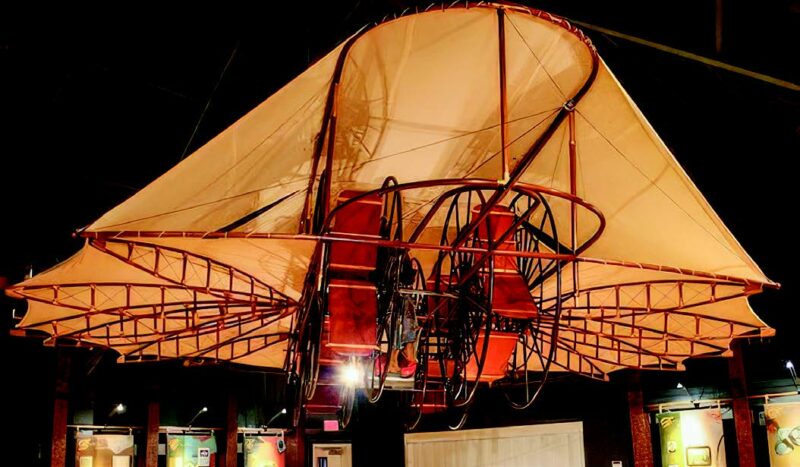
The exhibit is just one of many celebrating the achievements of people from Northeast Texas and Pittsburg. David Abernathy, museum board chairman, is proud of what the museum has to offer. “It’s important to us to capture the history of Northeast Texas,” he says.
The Northeast Texas Fair is featured prominently in the museum’s collection. “At one time, it rivaled the Texas State Fair,” David says. Railroad sidings took passengers to the fair, and another aviation first happened there––the first skydive.
Parachutist George A. Lamont had plans to jump from a hot air balloon. However, the weather wasn’t safe to send a balloon up, so George asked a pilot to take him up in his plane so he could jump. “Even the military hadn’t done it yet,” David says.
Memorabilia from Cavender’s Boot City, founded in Northeast Texas, is also featured. Another exhibit focuses on Mike Benet Formal Wear, a company started by two Pittsburg sisters whose dresses sold worldwide and were seen on the “Lawrence Welk Show” and in Miss America pageants.
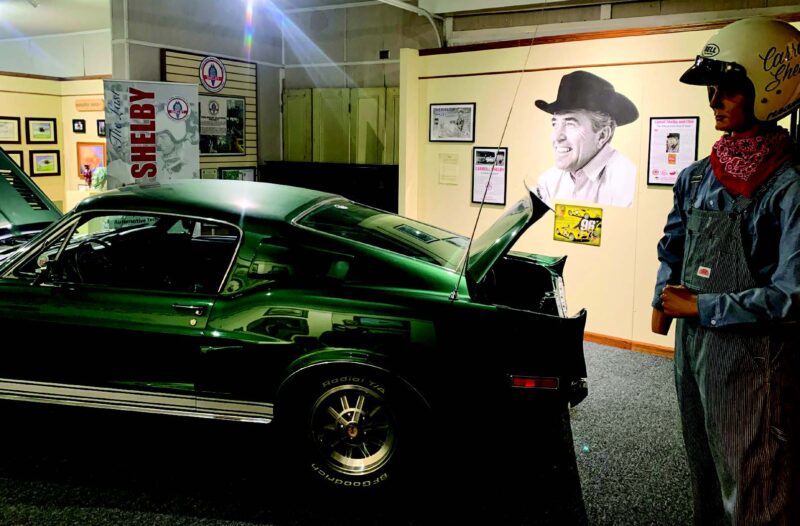
Famed race car driver and automotive designer Carroll Shelby established his namesake automotive technology training center at Northeast Texas Community College, and the museum has the last Shelby GT 350 that he purchased.
One of the oldest houses from the region sits on the museum grounds, furnished as it would have been in the early 1900s. “School kids can see what it was like to live before there was electricity and running water,” David says.